Introduction
Portfolio diversification is one of the most quoted principles in investing, and one of the most superficially understood. Most investors agree that diversification is good. Far fewer can explain what genuine diversification looks like, why it works, and where its limits lie. The result is portfolios that appear diversified on the surface but actually carry concentrated risks the owner does not realize.
This article explains how diversification really works, the layers at which it operates, and how to evaluate whether your own portfolio is genuinely diversified. The aim is practical understanding rather than the textbook version that obscures the more useful nuances.
What Diversification Actually Does
Diversification reduces the impact of any single investment performing poorly. Spreading money across many different holdings means that the failure of one or even several does not devastate the total portfolio. Mathematically, combining investments whose returns do not move in lockstep produces a portfolio with lower volatility than any single component for similar expected returns.
The key word is correlation. Investments with low correlation move differently from each other. Combining them produces smoother overall results than holding either alone. Investments with high correlation move similarly, so combining them produces little benefit.
Layers of Diversification
Across Companies
Holding many companies instead of one or a few reduces single-company risk. Owning 500 companies through an S&P 500 index fund makes the failure of any single company nearly invisible to total returns.
Across Sectors
Different sectors of the economy perform differently in different conditions. Technology, healthcare, utilities, financials, and consumer staples respond to different forces. A portfolio holding only technology stocks, even if spread across many tech companies, is concentrated by sector.
Across Geographies
Different countries and regions have different economic cycles, currencies, and political environments. A portfolio holding only US stocks is exposed to US-specific risks. Adding international developed and emerging market stocks broadens diversification.
Across Asset Classes
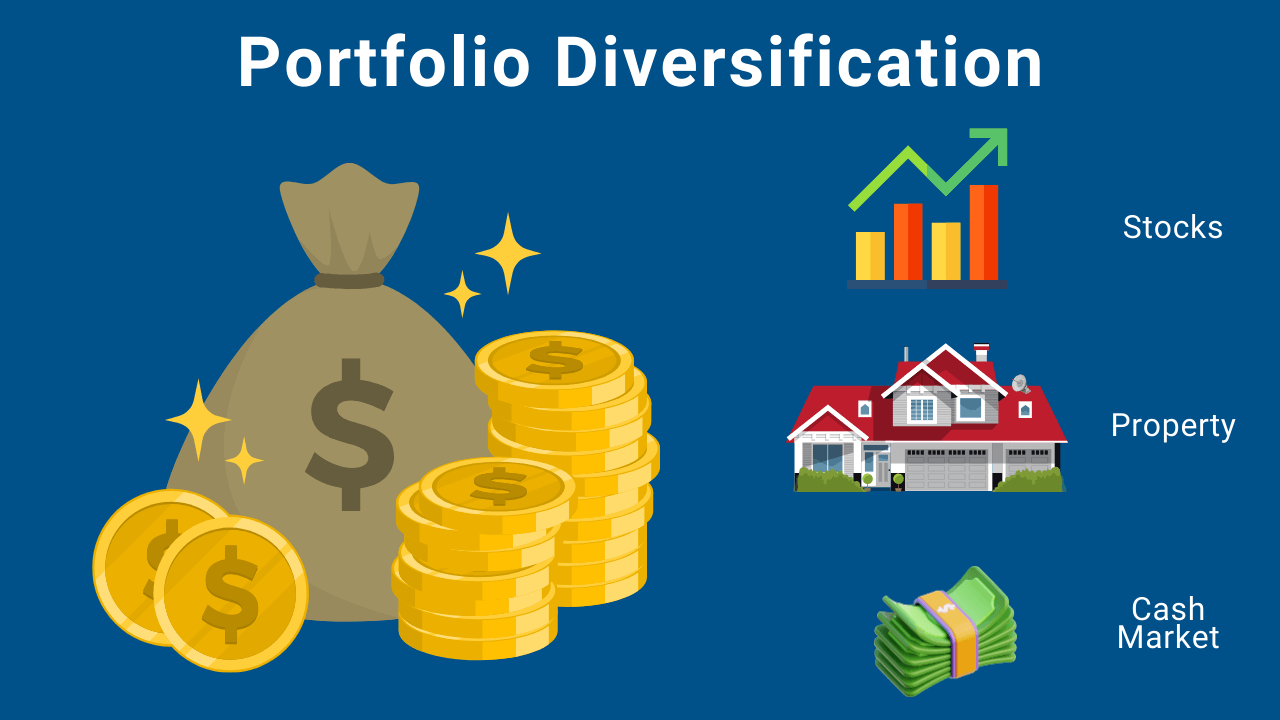
Stocks, bonds, real estate, and cash respond to different economic conditions. Stocks tend to do well during growth. Bonds often hold up better during downturns. Real estate has its own cycles. Combining asset classes reduces overall portfolio volatility.
Across Investment Styles
Within stocks, value and growth styles, large and small companies, and various factor exposures all behave differently in different periods. Some investors deliberately tilt toward specific factors. For most, broad market exposure captures the major segments naturally.
Across Time
Diversifying when you invest, by spreading contributions over time rather than buying everything at once, reduces the risk of investing at a particularly unfavorable price level. Dollar-cost averaging is the simple form of this.
The Limits of Diversification
Diversification reduces specific risk, the risk associated with individual investments. It does not eliminate market risk, the risk that affects all investments simultaneously.
During severe market downturns, correlations often rise. Most assets fall together, at least temporarily, regardless of how diversified the portfolio is. This pattern is sometimes called the diversification breakdown. The portfolio still benefits from diversification over longer periods, but in the short term, even well-diversified portfolios can decline meaningfully.
Diversification also has diminishing returns. Adding the 50th holding to a portfolio that already has 100 broadly diversified holdings adds little benefit. Beyond a certain point, more holdings just complicate management without meaningfully reducing risk.
Common Diversification Mistakes
Owning Many Funds That Do the Same Thing
Five different US large-cap mutual funds do not provide much diversification. They mostly own the same companies. True diversification requires holdings that differ from each other, not just different fund names.
Concentration Through Employer Stock
Workers who hold large amounts of their employer’s stock face double risk. Their job and their savings depend on the same company. Limiting employer stock to a small portion of total investments protects against this concentration.
Home Country Bias
Many US investors hold portfolios that are nearly all US stocks. The US market is large and important, but it is not the only market. International diversification reduces dependence on US-specific outcomes.
Overweighting Recent Winners
Investors often add new contributions to whichever fund has performed best recently. Over time, this skews allocations toward areas that have already done well, often at peak valuations. Rebalancing back to target allocations counteracts this drift.
Ignoring Sector Concentration
Even broad market index funds can have sector concentration. The S&P 500 in 2026 has substantial exposure to large technology companies. Investors thinking they are fully diversified through the index may have more tech exposure than they realize.
How to Build a Diversified Portfolio
For most investors, a diversified portfolio is simpler to build than financial industry marketing suggests.
Three-Fund Approach
A combination of total US stock market, total international stock, and total bond market funds covers the major asset classes with broad diversification. Allocations adjust based on age and risk tolerance.
Target-Date Funds
These hold diversified portfolios across asset classes and adjust the mix automatically as retirement approaches. They are appropriate one-decision solutions for many investors.
Robo-Advisor Portfolios
Robo-advisors construct diversified portfolios across asset classes, sectors, and geographies with rebalancing and tax optimization included. They reduce decision points to a few high-level questions.
Adding Tilts and Adjustments
Once a diversified core is in place, some investors add modest tilts based on convictions or preferences. Adding small allocations to specific sectors, factor-based funds, REITs, or international small-cap funds can express views without dramatically changing the portfolio’s character.
The key is keeping these tilts modest. Aggressive tilts effectively concentrate the portfolio and reduce the benefits of diversification. A 5 percent tilt expresses a view. A 50 percent tilt is a different portfolio entirely.
Rebalancing as Maintenance
Diversification erodes over time without maintenance. Strong-performing assets grow into a larger share of the portfolio, increasing concentration in whatever has done well recently. Rebalancing periodically returns the portfolio to its target allocation.
Once or twice per year is usually sufficient. Some investors rebalance when allocations drift more than a defined percentage from target. Either approach works as long as it is followed consistently.
Diversification in Different Account Types
Diversification should be evaluated across all your investment accounts together, not within each one separately. Holding bonds in a tax-advantaged account and stocks in a taxable account is fine if the overall mix matches your target. The aggregate picture is what matters for risk management.
Quality Over Quantity
True diversification is about owning a thoughtful mix of genuinely different exposures, not about owning many different things. Twenty broadly diversified ETFs may not be as diversified as three carefully chosen ones. Reviewing the actual holdings of your funds, not just their names, reveals the real diversification picture.
Conclusion
Diversification is one of the most reliable principles in investing, but it requires more thought than most investors give it. Spreading risk across companies, sectors, geographies, and asset classes produces portfolios that handle a wide range of outcomes. The benefits compound over time as different parts of the portfolio take turns leading. Investors who understand diversification properly avoid the mistake of feeling diversified while actually holding concentrated risks. The simple version of diversification, achieved through broad index funds covering major asset classes, captures most of the benefits available. More sophisticated approaches add modest improvements but rarely transform outcomes.
FAQs
How many investments do I need for adequate diversification?
Through broad index funds, you can hold thousands of companies with just a few funds. The number of holdings matters less than the diversity of what is held.
Does diversification mean lower returns?
Not necessarily. Diversification reduces volatility. Long-term returns depend more on asset allocation than on the number of holdings within each asset class.
Can I be too diversified?
Yes. Beyond a certain point, additional diversification adds complexity without meaningful benefit. Twenty overlapping funds may produce no more diversification than three well-chosen ones.
Should I diversify across crypto, commodities, and alternatives?
These can add diversification but also volatility and complexity. Most investors do well with traditional asset classes. Alternatives should be a small portion if used at all.
How does diversification work during a market crash?
Correlations often rise during severe downturns, reducing short-term diversification benefits. Long-term benefits remain because different asset classes recover at different rates and times.